History of Gold in Alaska
Why Alaska became one of the world's most famous gold frontiers — and where that legacy lives on today.
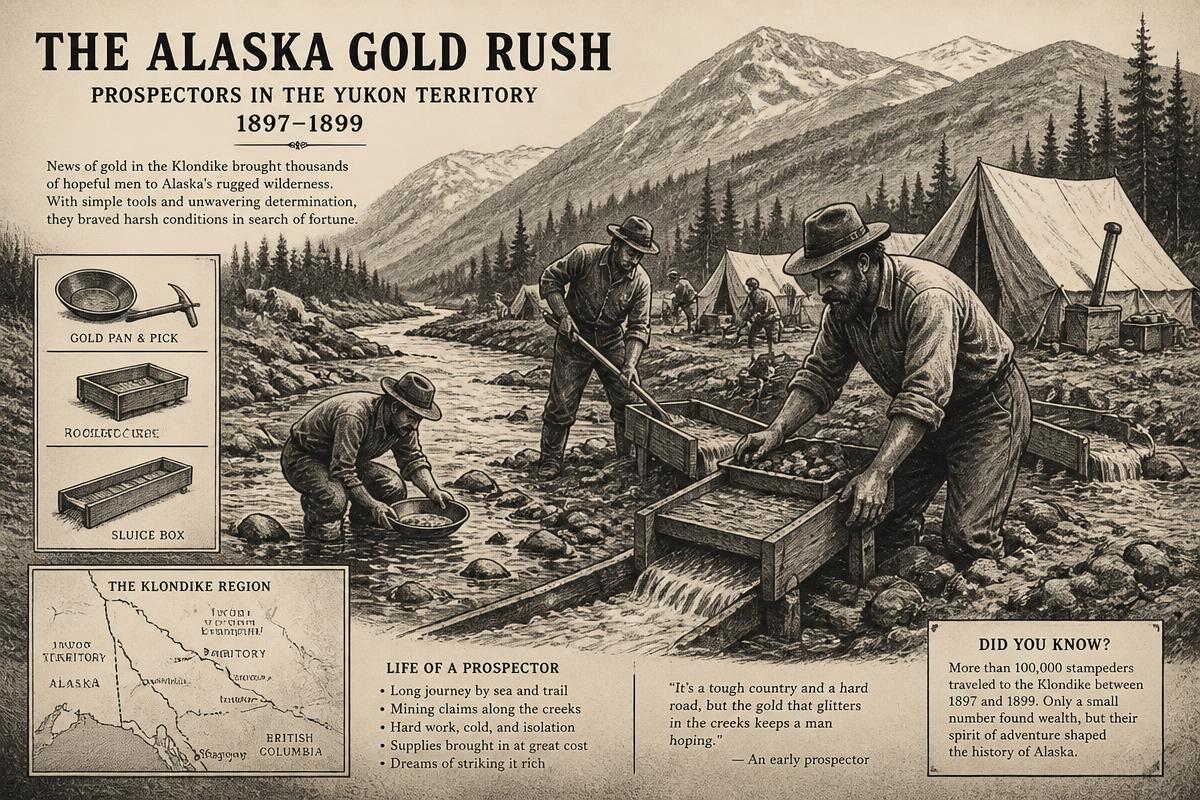
Illustration of prospectors during the Klondike Gold Rush era.
Alaska's relationship with gold stretches back thousands of years. Long before prospectors arrived with pans and sluice boxes, Indigenous peoples of the region valued gold for trade and ornament. But it was the late 19th-century discoveries that transformed Alaska into an international symbol of fortune and adventure.
The Klondike Gold Rush, 1896–1899
The rush began just across the border in Canada's Yukon Territory, but Alaska was the gateway. In 1896, prospectors found gold on Bonanza Creek, a tributary of the Klondike River. By 1897, news reached Seattle and San Francisco, and an estimated 100,000 people set out for the Yukon and Alaska.
Most stampeders traveled through the port of Skagway, then climbed the brutal Chilkoot or White Pass trails toward the Yukon River. The journey killed many and bankrupted more. Historians estimate that only about 30,000 to 40,000 people reached the Klondike, and only a minority found meaningful gold.
Nome: Gold on the Beach
In 1898, prospectors Jafet Lindeberg, Erik Lindblom, and John Brynteson discovered gold near Cape Nome. The following year, a spectacular strike was made on Nome's beaches. Unlike the Klondike, Nome's gold sat in beach sands accessible without a pickaxe — anyone could pan or shovel sand.
By 1900, Nome was a tent city of thousands. The beach deposits were rich but shallow; as the easy gold ran out, miners turned to dredging offshore and along the tundra streams. Today, Nome remains one of the most accessible places in Alaska to see active gold mining.
Fairbanks and Interior Alaska
Fairbanks was founded in 1901 after Felix Pedro, an Italian immigrant prospector, found gold in the Tanana Valley. The Fairbanks area proved to be one of Alaska's most productive gold regions, with both placer and lode deposits. The Pedro Dome and surrounding creeks produced millions of dollars in gold during the early 1900s.
The region's mining heritage is still visible at places like Gold Dredge 8 and the El Dorado Gold Mine, which offer tours and gold panning experiences for visitors.
Modern Recreational Panning
Today, most gold mining in Alaska is industrial, but recreational panning survives as a popular outdoor activity. Visitors can pan at established attractions, try public access streams, or join guided tours. The gold found is typically fine flakes and tiny pickers rather than nuggets, but the experience connects modern adventurers to one of Alaska's defining stories.
Key Historical Takeaways
- The Klondike Gold Rush put Alaska on the world map as a land of opportunity and hardship.
- Nome's beach gold made prospecting accessible to ordinary people without heavy equipment.
- Fairbanks became a lasting mining center and still anchors Alaska's Interior gold country.
- Recreational panning today is about experience and history as much as profit.