How to Pan for Gold
The classic technique is simple in principle but takes practice. Follow these steps to give yourself the best chance of finding color.
Find the Right Spot
Look for places where gold is likely to settle: inside bends of a stream, behind large boulders, in bedrock cracks, and at the downstream end of gravel bars. Gold is heavy, so it drops where water slows.
Fill Your Pan
Scoop gravel and sand from the bottom of the stream bed into your pan. Break up clay balls and remove large rocks. Fill the pan roughly three-quarters full of material.
Submerge and Stratify
Hold the pan under water and use both hands to shake it side to side. This stratifies the material by weight: heavy grains sink to the bottom, light sand rises to the top.
Wash Off the Light Stuff
Tilt the pan away from you and dip the front edge into the current. Shake and swirl so the lighter sand and gravel wash out over the rim. Gold, being dense, stays on the bottom.
Settle and Repeat
Continue the stratify-and-wash cycle. Every few motions, settle the pan flat and tap it to drive gold to the bottom. Be patient — rushing washes away fine gold.
Inspect the Black Sand
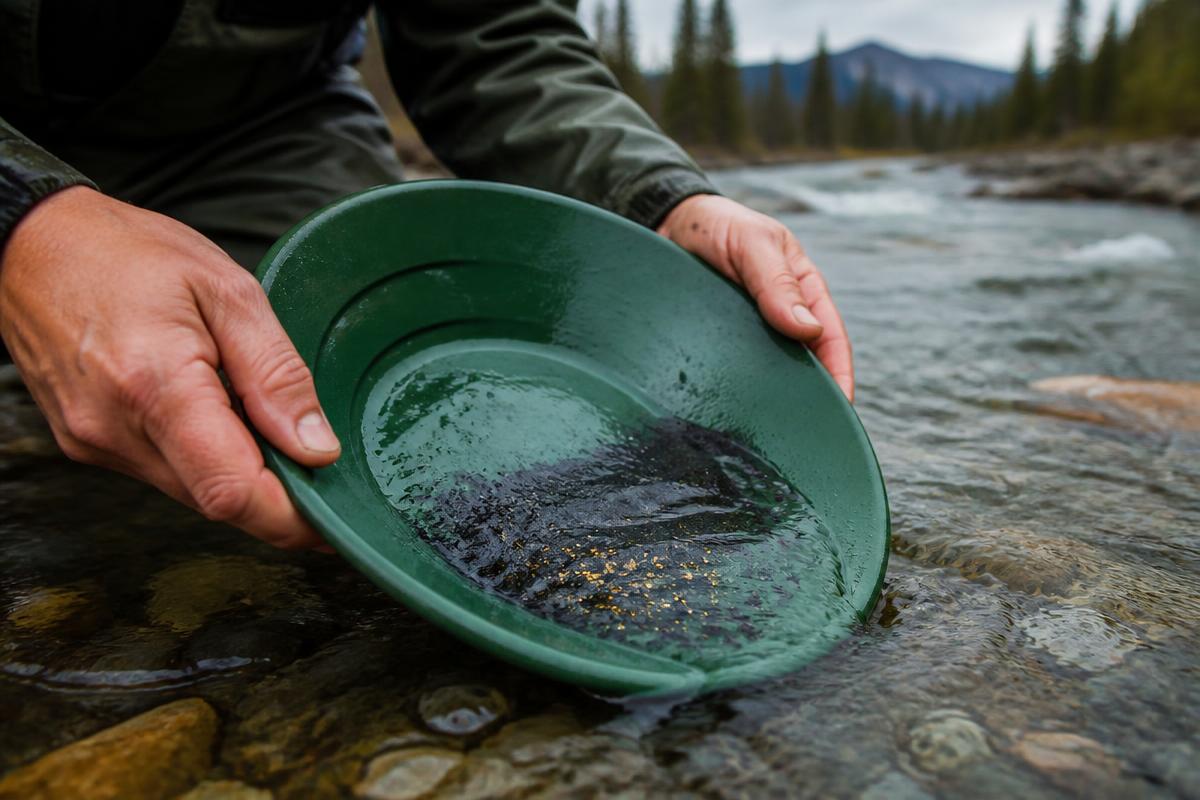
When only a small amount of dark, heavy sand remains, look for bright yellow flakes and specks. Use a snuffer bottle to suck up visible gold, then transfer it to a vial.
Quick Tips
- •Keep the pan in the water as much as possible to avoid losing fine gold.
- •Use a classifier to remove larger gravel before you start panning.
- •Work slowly; most beginners lose gold by washing too aggressively.
- •Gold often hides in the last bit of black sand — don't give up early.
- •Practice at home with dirt and small lead shot to build muscle memory.
Why This Works
Gold has a specific gravity of about 19.3, making it much heavier than sand, gravel, and most other streambed materials. When you shake a pan, the densest particles sink to the bottom. By repeatedly washing away the lighter top layers, you gradually concentrate the heavy minerals — including gold — into a small pile of black sand that you can inspect.
In Alaska, much of the gold is fine placer gold: tiny flakes and flour gold rather than nuggets. Fine gold is easily lost, so gentle technique and patience matter more than brute force.